
Your current website is bleeding traffic because search engine behavior has fundamentally changed. Optimizing exclusively for human clicks while ignoring autonomous machine execution means your brand is actively logging a 100% conversion failure rate for the internet’s highest-converting buyers.
100% Agent Abandonment — Your website’s human-first architecture results in a near-100% abandonment rate for autonomous AI agents.
The Intermediated Revenue Gap — You are missing the internet’s highest-converting traffic channel, as AI-referred traffic converts 42% better than traditional channels.
Conceding the Trillion-Dollar Pipeline — Delaying an upgrade risks conceding future multi-trillion-dollar B2B purchasing power to competitors who are machine-readable.
Extractive Efficiency Deployment — Penpixel Creative specializes in re-engineering your digital estate for Extractive Efficiency, making your business transactable to autonomous AI models.
For twenty-five years, B2B SaaS companies have built digital storefronts under a single assumption: your visitor is a human who reads copy, scrolls grids, and manually fills out form fields.
That assumption is now a financial liability.
Today, the visitor arriving at your site is increasingly an autonomous AI agent. Runtimes like ChatGPT Atlas, Google’s Project Mariner, and Perplexity Comet are actively filling forms, researching vendors, and executing transactions on behalf of real corporate buyers.
If your website architecture hasn’t evolved past the legacy human-first layout, you are exposed to immediate, compounding financial risks. Here is exactly what it costs to do nothing.
1. You Are Funding a 100% Agent Abandonment Rate
When a human navigates your self-serve signup flow or interactive pricing grid, the industry average abandonment rate hovers around 70%. It’s a number that traditional growth teams spend millions trying to chip away at through superficial layout adjustments and cosmetic color modifications.
When an autonomous AI agent hits that exact same visual layout, the abandonment rate climbs to nearly 100%. This statistic makes logical sense: if an agent cannot parse your site cleanly, it will not waste time trying to figure it out; it will simply leave, and you get no second chances. Remember, agents do not “see” your brand colors; they cannot execute or interpret client-side JavaScript menus; and they fail silently when forced to guess at complex visual cues.
That silent failure should concern you. Without feedback, how do you know what to address?
If your signup pipeline, quote calculator, or checkout workflow relies entirely on a visual human interface rather than open, machine-readable protocol standards, the agent will leave. To capture this automated pipeline, your website must transition to dedicated machine contracts:
- The Agentic Commerce Protocol (ACP): Co-developed by OpenAI and Stripe, this open standard bypasses traditional human-facing web pages entirely. Instead, the merchant backend connects directly to the machine via a programmatic framework. The AI agent renders the user interface within its own platform (like ChatGPT), updates checkout states dynamically via specialized API endpoints, and processes payments securely via programmable Shared Payment Tokens, so actual credit card credentials are never exposed to the agent or merchant.
- The Universal Commerce Protocol (UCP): Co-developed by Shopify and Google, this framework operates like a universal language for the multi-agent web. Rather than scraping structural HTML, agents query a dedicated backend discovery endpoint at /.well-known/ucp to understand exactly what your platform can do. This allows interfaces like Google AI Mode or Gemini to conduct real-time catalog and inventory queries, modify multi-item carts, and securely link user loyalty accounts via OAuth 2.0 to dynamically preserve member pricing and discounts.
If your digital estate forces an autonomous agent to browse your human interface instead of exposing these protocol-ready architectures, it will abandon the thread entirely. You aren’t just losing an organic click; your brand is functionally invisible to the pipeline.
2. You Are Missing the Internet’s Highest-Converting Channel
The modern buyer’s journey is heavily intermediated. Traditional traffic metrics are dropping because 69% of Google searches now resolve without a single click, and AI Overviews siphon away 58% of the organic volume that used to reach the #1 ranking.
However, looking strictly at declining pageviews misses the real revenue movement. Data from Q1 2026 reveals that AI-referred traffic converts 42% better than traditional non-AI traffic channels.
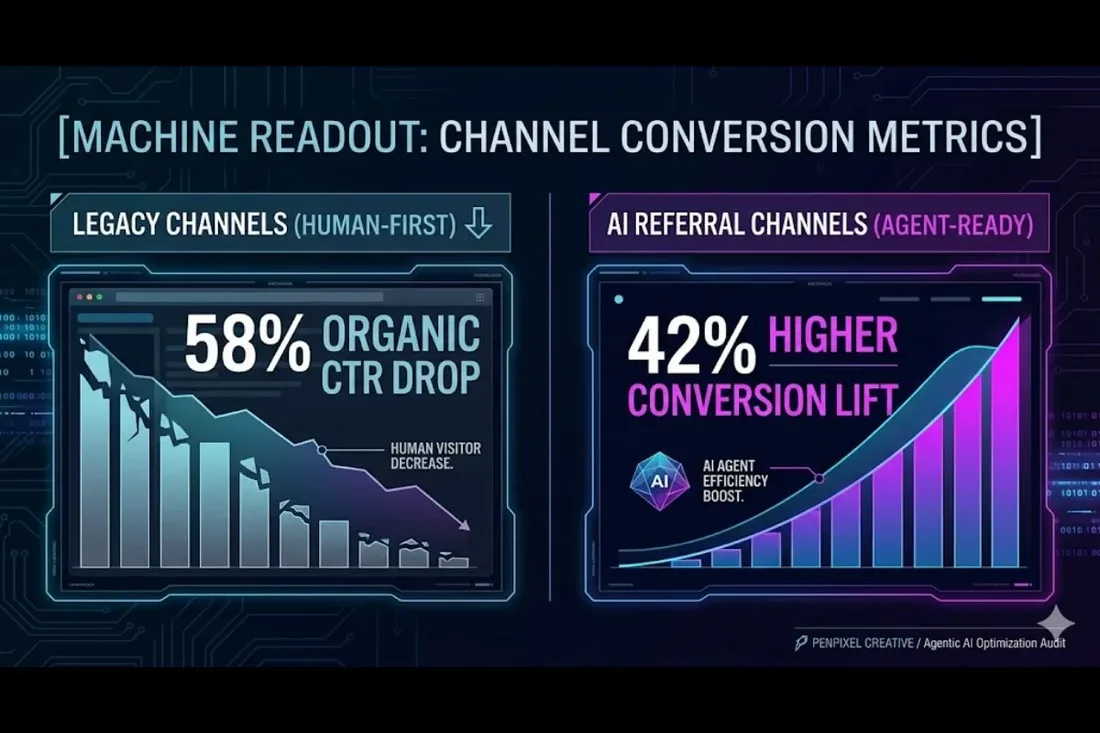
The volume of traditional clicks is shrinking, but the traffic remaining inside AI referral pathways is hyper-qualified and high-intent. Delaying a technical upgrade means you are actively turning away the highest-converting traffic channel the web has seen in two decades.
3. You are conceding a multi-trillion-dollar gatekeeper shift
Waiting to re-architect your digital infrastructure assumes you have time to iterate. The data suggests otherwise. Gartner projects that AI agents will dictate $15 trillion in B2B purchasing power by 2028, while McKinsey forecasts up to $5 trillion in orchestrated revenue by 2030.
AI systems exhibit strong “choice homogeneity” and position biases. They rely on what is called machine comfort bias—favoring structured data sources, server-side rendered HTML, and clean capability manifests that they can verify with absolute confidence.
Once an engine establishes a preferred data framework within your market vertical, it embeds that source into its autonomous workflows. The longer you remain unreadable to machines, the deeper your competitors entrench themselves as the default recommendation.
How Penpixel Creative Solves the Revenue Gap
Traditional digital agencies are fundamentally unbuilt for machine optimization. They treat the current shift as a content copywriting exercise or an SEO tweak.
At Penpixel Creative, we approach this as an architectural necessity. We re-engineer your B2B SaaS digital estate for Extractive Efficiency—ensuring your pricing models, documentation, and product tiers are immediately accessible, interpretable, and usable by autonomous AI models.
We liquidate your legacy technical debt and move your value proposition directly into the machine interfaces where purchasing decisions are made. We don’t just optimize your web pages; we make your entire business transactable to machines.
Stop Guesstimating Your Machine Visibility
If you cannot explain why your organic performance is shifting, or if your current team lacks a clear roadmap for protocol readiness, you are operating with an expensive blind spot.
Let us diagnose exactly how AI platforms interpret, cite, or ignore your SaaS brand.
↳ Secure Strategic Clarity. Contact Penpixel Creative Today.
Frequently Asked Questions
What is the difference between optimizing for an AI search engine (AEO) and an AI agent (AAIO)? Answer Engine Optimization (AEO) targets the content layer so models can quote your brand in synthesized search results. Agentic AI Optimization (AAIO) configures your technical infrastructure so that autonomous machines can execute complex workflows, such as signups, without human intervention.
Why do AI agents experience a near 100% abandonment rate on conventional human-first websites? Conventional websites rely on visual layouts and client-side scripts that non-human visitors cannot natively interpret. Lacking a machine-readable protocol layer, agents hit a fatal context break and abandon the session instantly.
If our website traffic is dropping due to zero-click AI search layouts, why shouldn’t we just rewrite our marketing copy? Rewriting text treats an architectural delivery problem as a simple content copywriting issue. AI models prioritize raw structural data over marketing fluff, persuasive rhetoric, or classic keyword stuffing.
What exactly are ACP and UCP, and do we have to choose between implementing them? ACP is an OpenAI-Stripe standard that manages secure checkout lifecycles via programmable Shared Payment Tokens. UCP is a Google-Shopify framework that enables live inventory queries and direct linking to loyalty programs. You can serve both simultaneously.
What is “machine comfort bias,” and how does it create an immediate financial risk for slow movers? AI platforms show a preference for verified data structures that minimize computational processing friction and token waste. Slow upgraders risk being permanently excluded as engines entrench readable competitors into their automated buyer workflows.